If you’ve searched anything like “does the EU AI Act apply to UK businesses” or “when does the EU AI Act come into force,” you’ve probably landed on pages written for enterprise compliance teams, full of Annex references and conformity assessments that mean very little if you’re running a small business or a startup.
This post is the plain English version.
What the EU AI Act actually is, who it applies to, what’s changed recently, and what you can realistically do about it this month, not in six months’ time when you finally find an hour to sit down with a 40 page PDF.
Is the EU AI Act in force?
Partly, yes.
The EU AI Act didn’t arrive all at once, it’s been rolling out in stages since it entered into force in August 2024.
Some parts are already active, including bans on the most harmful uses of AI, which have applied since February 2025.
Other parts are still being phased in.
Most recently, the Article 50 transparency obligations, the rules requiring businesses to tell people when they’re interacting with AI, came into force on 2nd August 2026.
If you run a chatbot, use AI generated content, or have any AI-powered customer touchpoints, this is the part that’s live right now.
Does the EU AI Act apply to UK businesses?
Yes, it can, and this catches a lot of UK business owners out.
The EU AI Act works in a similar way to GDPR: it doesn’t matter where your business is based, what matters is whether your AI systems affect people in the EU.
If you:
- sell to EU customers,
- have EU-based clients,
- or your AI tool’s output reaches anyone in the EU, even in a small way,
you may fall within scope.
This is one of the most common things people search for, and the honest answer is: don’t assume it doesn’t apply to you just because you’re a small operation based in Scotland or elsewhere in the UK.
Who does the EU AI Act apply to?
Broadly, anyone who:
- Develops or provides AI systems used in the EU
- Deploys AI tools within their business that affect EU-based customers
- Has AI output (content, decisions, recommendations) that reaches people in the EU
This applies regardless of company size.
There are some proportionate concessions for smaller businesses, which we’ll cover below, but “we’re too small for this to matter” isn’t a safe assumption to make without checking.
When does the EU AI Act come into force? (The bit that recently changed)
This is the question worth paying closest attention to, because the answer changed significantly in 2026, and a lot of the guidance still online hasn’t caught up.
Originally, the AI Act’s high-risk system obligations were due to apply from 2nd August 2026.
In June 2026, the European Parliament approved a delay, known as the Digital Omnibus, pushing that deadline back:
- Transparency obligations (Article 50): still apply from 2nd August 2026, unchanged
- High-risk system obligations (Annex III): postponed by 16 months, to 2nd December 2027
- High-risk AI in regulated products (medical devices, machinery, vehicles): postponed to August 2028
In practice, that means there are now two separate clocks running, not one single deadline.
Which one applies to you depends on what kind of AI you’re using, not just when you’re using it.
What does the EU AI Act regulate?
The Act sorts AI systems into four risk categories, and your obligations depend entirely on which category you fall into:
- Unacceptable risk – banned outright (manipulation, social scoring, and similar practices)
- High risk – strict requirements, covering things like recruitment tools, credit scoring, and access to essential services
- Limited risk – transparency obligations, covering chatbots and AI-generated content, this is the category most small businesses will fall into
- Minimal risk – no mandatory obligations, covering things like spam filters and basic recommendation tools
What is EU AI Act compliance for a small business, realistically?
This is where most of the enterprise-focused guidance falls down.
For a small business, compliance isn’t usually about conformity assessments and technical documentation, it’s about getting the fundamentals right:
- Knowing what AI tools your business actually uses, including free tools nobody’s officially signed off
- Being clear with customers when they’re interacting with AI
- Understanding where your customer data goes once it’s inside an AI tool, and how that sits alongside GDPR
- Having at least a basic policy in place for how AI is used across your business
None of that requires a legal department.
It requires an hour, the right guidance, and a checklist that’s actually written for your size of business.
A free Masterclass built for small businesses, not enterprise compliance teams
Most of what’s out there on the EU AI Act is written for organisations with dedicated compliance and legal teams.
We built something different.
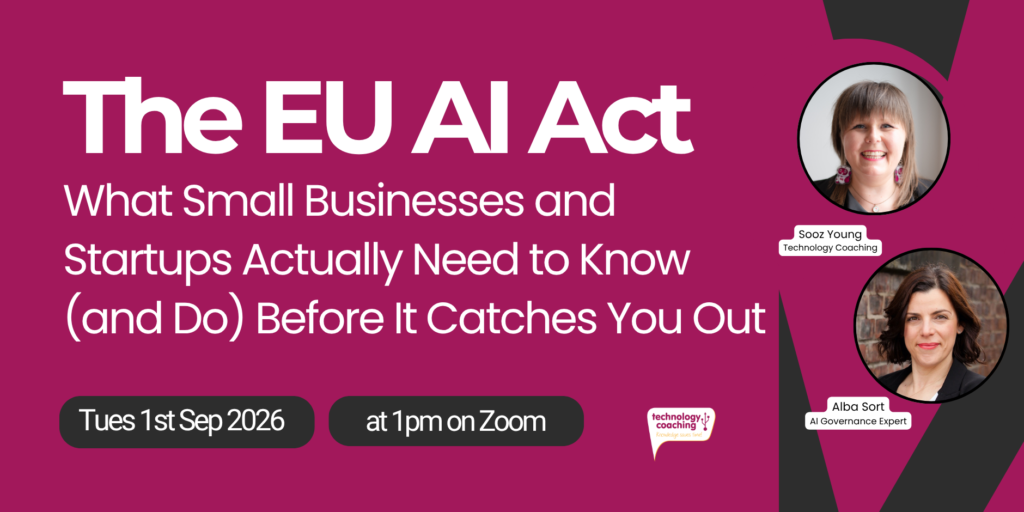
The EU AI Act: What Small Businesses and Startups Actually Need to Know (and Do) Before It Catches You Out
📅 Tuesday 1st September 2026
🕐 1pm, on Zoom
Hosted by Sooz Young (Technology Coaching) and Alba Sort (AI Governance Expert), this free masterclass covers exactly what’s in this post, in more depth, with time for your specific questions.
Every attendee also leaves with a practical checklist, built specifically for small businesses.
Have a specific question about how the EU AI Act applies to your business?
Bring it along to the session, or get in touch with Technology Coaching directly.