
What human skills actually keep you relevant now that AI can draft, design and produce almost anything?
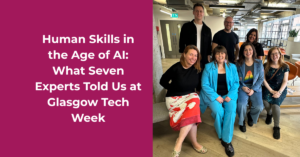
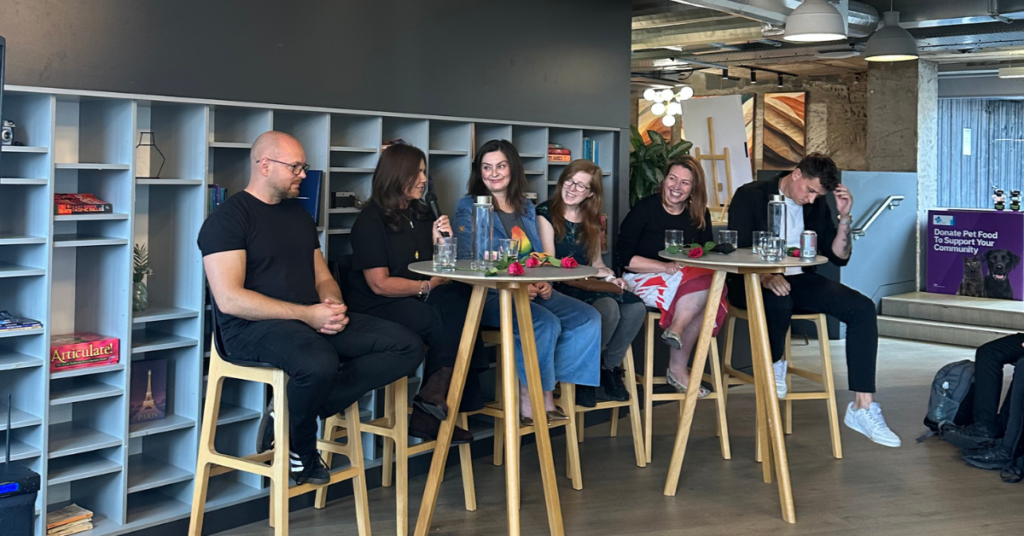
That was the question at the centre of Humans & AI: The Skills That Keep You Relevant, the Glasgow Tech Week event I hosted at Clockwise on 8 September.
Myself and six speakers;
spent two hours in honest, unscripted conversation with a room full of people asking exactly the questions you’d want asked.
This is exactly what a fireside chat at Technology Coaching is – people who work with AI every day, being straight about what it’s actually doing to how we work.
Here’s what came out of the room.
Why we built this event
The first question of the day set the tone for everything after it.
An attendee named Thea, who runs a content company, put it simply.
She has a love-hate relationship with AI.
She uses it constantly, but she’s also craving real human connection, and she wanted to know how to find that balance before, in her words, “the robots take over.”
That tension, using AI all day while still wanting to stay human, is exactly why this event existed.
It’s not a hypothetical problem.
It’s what most of the room is living through right now.
The room in numbers
We had 116 registrants for the event. With around 64 attendees showing up live.
In Glasgow specifically, when we run free events we have to setup an event based upon the number that we expect to be in the room. I usually plan for 50% + 10% additional spaces on the booking. As the drop off rate for free events is huge. This is what I’ve coined as the ‘freeonomy’ culture. So a 64 showup rate, is pretty good for the amount of registrants.
We ran live polling throughout the event, so rather than guess at who was in the room, here’s what the data actually says.
Close to 50 people took part in the polls. Nearly 8 in 10 were already using AI regularly or would call themselves an expert, which tells you something important straight away. This wasn’t a room that needed convincing AI is useful. It was a room trying to work out what comes next, once the novelty wears off.
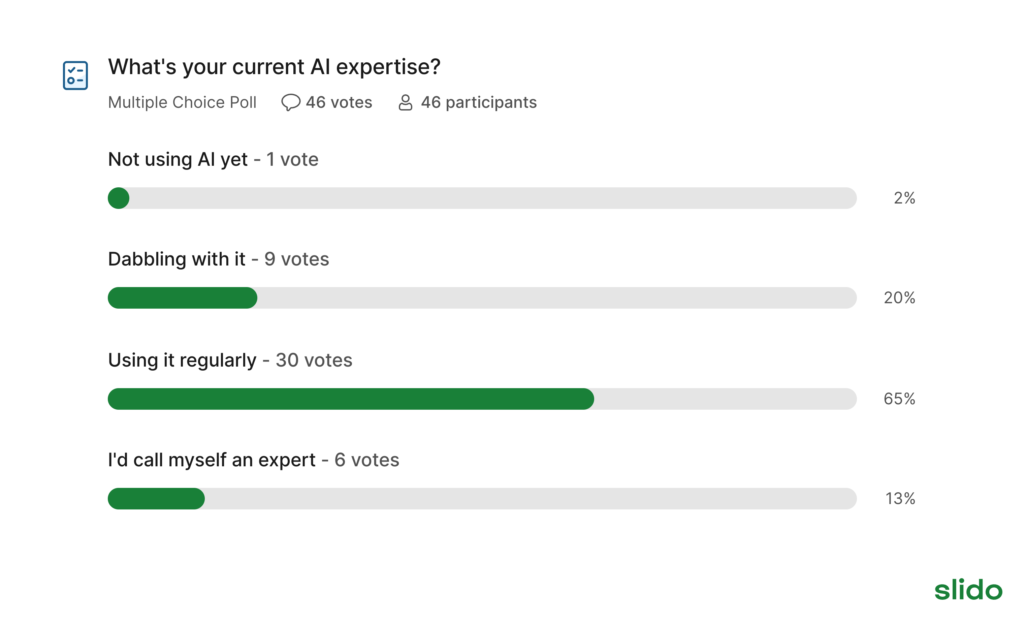
Image: Slido poll, “What’s your current AI expertise?”
- 65% are using AI regularly
- 13% called themselves an expert
- 20% are still just dabbling with it
- 2% aren’t using it yet at all
The room itself was a genuine mix, not weighted toward any one type of attendee.
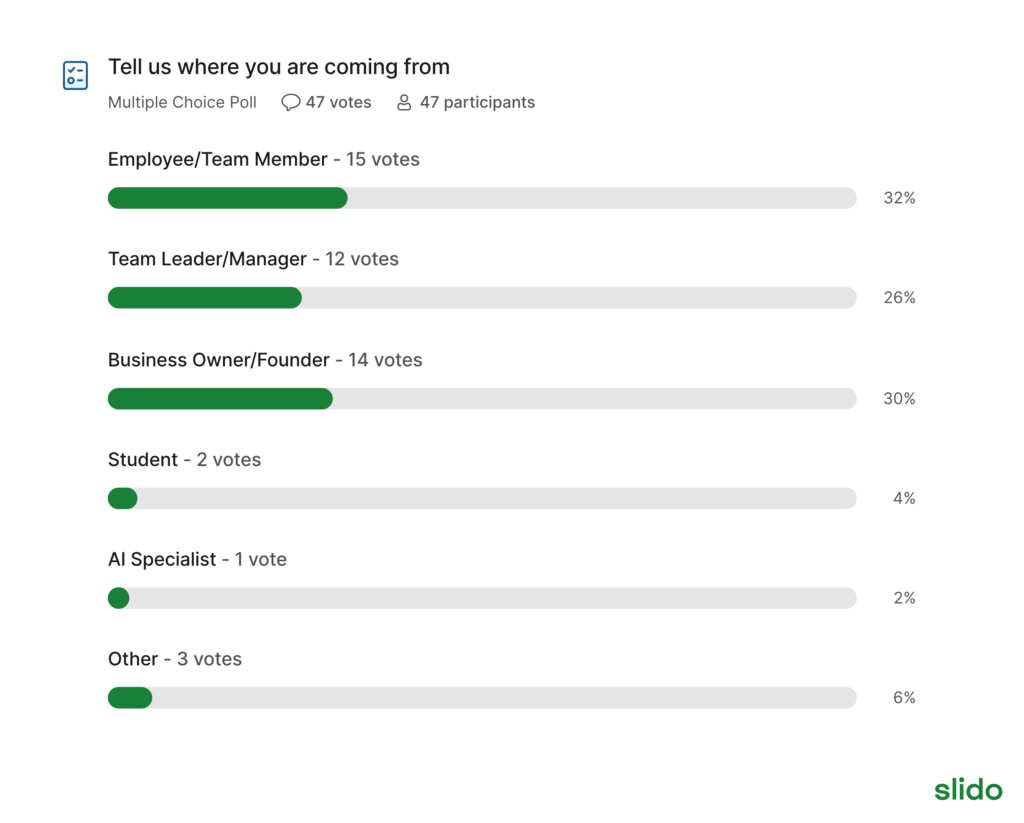
Image: Slido poll, “Tell us where you are coming from”
- 32% employees or team members
- 30% business owners or founders
- 26% team leaders or managers
- The rest a mix of students, AI specialists and other roles
And the questions coming in through the event told their own story.
Of the questions submitted live, 82% were neutral in tone, measured and exploratory rather than anxious or hostile, with 12% leaning negative and a small 6% positive.
That matches the tone in the room.
This wasn’t a crowd panicking about AI, it was a crowd thinking carefully about it.
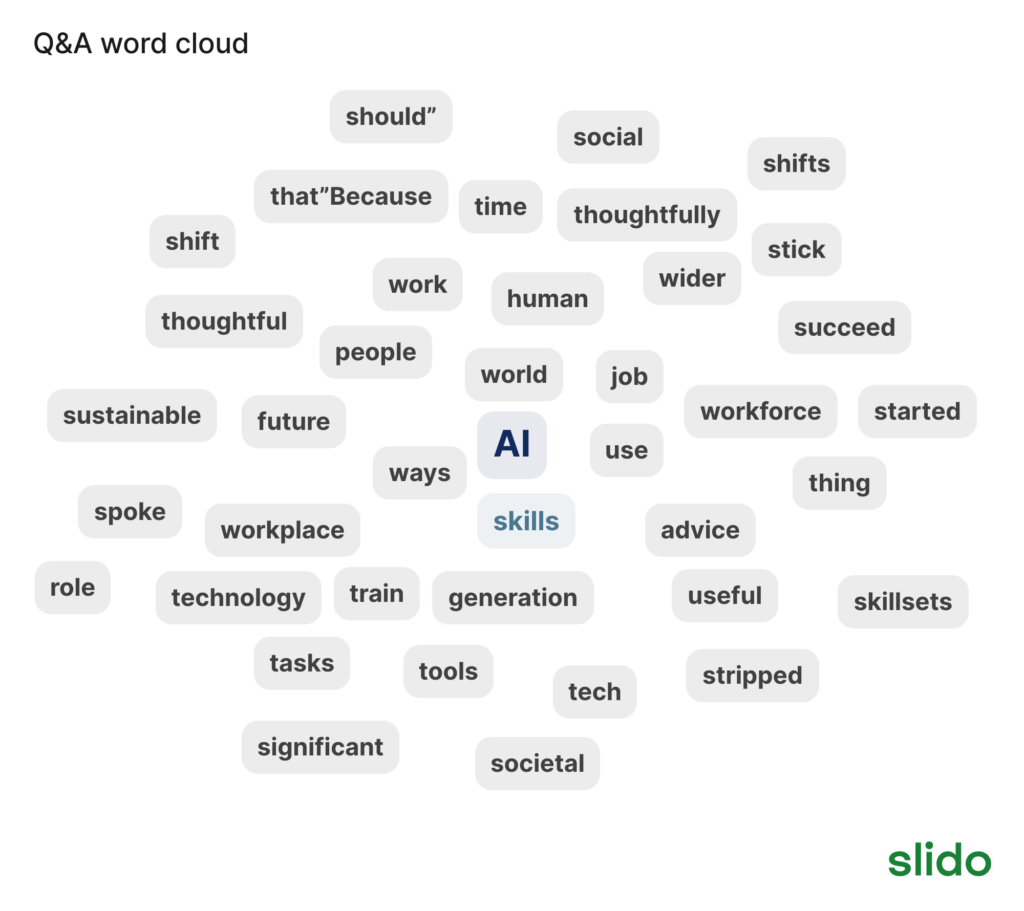
The word cloud from the live questions backs that up.
The words that came up again and again were AI, skills, human, work, future, workforce and workplace, sitting alongside more values-driven language like sustainable, thoughtful and societal.
That’s not the vocabulary of a room worried about losing its job to a robot by Friday.
It’s the vocabulary of a room asking bigger, slower questions about what all of this means for how we work and live.
Stop fixing your deficits. Start using your assets.
One of the strongest reframes of the day came early.
Most of us spend our energy trying to fix what we’re bad at, often by reaching for an AI tool to patch the gap.
The panel argued that’s backwards.
The bigger opportunity isn’t fixing your weaknesses, it’s making your actual strengths sharper.
That idea led somewhere more uncomfortable.
We’re often too scared to fail, but we’re also too scared to succeed, so a lot of talented people end up sitting in what one speaker called the mediocre middle.
Not failing. Not succeeding. Just stuck, because saying “I’m genuinely good at this” feels boastful.
If you only take one thing from this post, take that.
Ask yourself what you’re brilliant at before you ask AI to fix what you’re not.
From production to direction
A theme that ran through the whole afternoon was a shift in what “doing your job well” actually means.
For a long time, being good at your job meant being good at producing something, an article, a design, a piece of code.
AI is very good at production now, and it’s only getting better.
What’s changing is that the valuable skill is shifting from making the thing to directing and judging it.
Setting the boundaries, being clear about what you want, and knowing whether what comes back is actually good.
That’s a genuinely different skill set, and it’s one most people were never taught, because until recently nobody needed it.
If you’re earlier in your career, this matters even more.
You may not get the traditional run of entry-level production work that built the judgement of the generation before you, so that judgement has to be learned deliberately instead of absorbed over years.
AI didn't remove the human process, it exposed it
There was a sharp point made about organisational design that’s worth sitting with if you run a team.
Every organisation that exists today was built for human-only intelligence.
All of our processes are shaped around the strengths and limitations of human communication and human collaboration.
Bolting AI onto that without rethinking the process rarely works.
The comparison drawn was the introduction of electricity.
At first, factories just replaced gas lamps with electric ones and changed nothing else.
It took years before anyone reworked the entire manufacturing floor around what electricity actually made possible.
AI is at that same early stage.
Most organisations are still swapping the lightbulb.
The real value shows up later, once someone rebuilds the process itself.
Your brain on AI: what the research actually says
This is the part of the day that got the most nervous laughter, and it’s worth being precise about, because it’s genuinely still being studied.
Researchers at MIT’s Media Lab ran a four-month study where participants wrote essays either unaided, using a search engine, or using ChatGPT, while wearing EEG headsets to track brain activity.
The ChatGPT group showed the weakest neural connectivity of the three, and struggled more to recall or quote their own work afterwards.
It’s an important early signal, though worth flagging that the paper is still a preprint and hasn’t been through peer review yet, so treat the findings as a strong early warning rather than a settled fact.
There’s also a well-known piece of psychology worth knowing here.
The Dunning-Kruger effect describes how people with less skill in an area tend to overestimate their ability, while genuinely skilled people tend to underestimate theirs.
It’s a useful lens for the “mediocre middle” problem above.
A lot of skilled people downplay exactly the thing they’re best at.
The panel’s practical takeaway wasn’t to avoid AI.
It was to stay intentional about when you use it and when you sit down and think something through yourself.
The authenticity problem: getting accused of being AI
One of the funniest and most telling moments of the day came from a simple question to the room.
Has anyone here been accused of being AI?
Multiple hands went up.
One speaker had been accused of it in someone’s LinkedIn DMs, for the crime of being too enthusiastic.
Another admitted to holding back their own writing voice because they worried it wouldn’t sound polished enough, and reaching for AI to smooth it over instead.
This isn’t a small, niche problem.
LinkedIn itself has spent the past year cracking down on what it calls “AI slop,” removing its own AI “enhance your post” writing tool and rolling out detection systems after users flagged AI-generated content over a million times in weeks.
The platform’s own product leadership has said the value of a post comes from the human behind the tool, not the tool itself.
If a platform built on AI features is walking some of them back because of authenticity concerns, that tells you something about where the market is actually heading.
Which sectors should actually worry
Toward the end of the day, an attendee named Stephen asked the panel directly.
Which sector skill sets should be most concerned about AI, and where is it having the most positive impact?
The clearest warning was about production-based roles.
If your entire skill set is producing pixels, words or code, and nothing more, that’s a genuinely vulnerable position, because AI is very good at production and it’s only going to get better.
One speaker shared a live example from the night before, roughly six hours of AI-assisted design work that produced what they estimated as two to three weeks of a senior designer’s output, for around £50 in tool costs against a rough £500-a-day rate for a human designer doing the same job manually.
That’s not a hypothetical.
That’s happening in real client work right now.
There was also a sharper reframe worth remembering.
Every new technology reveals a new category of risk.
Nobody needed a right to be forgotten until cameras could record everybody.
The camera comparison isn’t casual either.
When George Eastman’s Kodak camera made photography affordable to the general public in the 1890s, it directly prompted the first major legal writing on a right to privacy in America.
New technology creates new legal and ethical categories almost every time, and AI is doing the same thing now, just much faster.
Where AI is already changing things for the better
The positive side of the same question centred heavily on education.
AI used well can support critical thinking rather than replace it, echoing centuries-old Socratic methods of working through a problem by being questioned rather than told the answer.
That’s a genuinely useful application, particularly in colleges and universities.
The caution came around younger children.
Early years and pre-16 education is a formative period for how humans develop social and emotional skills, self-regulation and resilience, and some countries, Japan and Finland were named as strong examples, are being far more careful about how AI gets introduced into that stage of development than others.
Why physical presence still matters
There was an honest conversation about the pull back toward in-person work that’s worth including here, because it ties directly back to the human skills theme.
Several major employers have reversed pandemic-era flexibility.
JPMorgan Chase told its roughly 300,000 employees to return to the office five days a week starting in March 2025, reversing its hybrid policy entirely, with several engineering and consultancy firms following similar moves.
The panel’s read on this wasn’t nostalgia for commuting.
It was about shadowing, the kind of learning that only happens by watching someone else do a job in person, which is genuinely hard to replicate remotely and even harder to replicate through AI.
Communication is still the decisive skill
A theme that ran quietly under almost everything else discussed was language and communication.
One speaker shared a personal story about moving to Scotland from South Africa aged nine, misunderstanding her first conversation at a new school, and slowly learning to tune her ear to unfamiliar words and accents.
It’s a strong reminder that a huge amount of workplace friction isn’t about skill or intelligence at all, it’s about two people speaking different professional languages and assuming the other one isn’t listening.
The advice that came out of it was simple.
If someone tells you they don’t feel heard, the answer usually isn’t to talk louder.
It’s to ask better, more open questions.
This matters just as much when talking about AI systems themselves.
What you feed a language model is what you get out of it.
If the data training these systems reflects a narrow set of voices, cultures and experiences, the output reflects that same narrowness back at everyone who uses it.
Diversity in the room isn’t a nice-to-have here, it’s a direct input into whether the tools we build actually serve everyone.
On regulation, and why it's genuinely hard to get right
There’s no getting around how difficult regulating AI actually is, and this is exactly the ground we covered in our EU AI Act webinar earlier this month.
AI is fundamentally different to most technologies that came before it.
The internet’s core infrastructure has stayed broadly consistent since it launched.
AI is changing week to week.
Regulate too loosely and you risk real harm.
Regulate too rigidly and you risk strangling the innovation that could genuinely help people, and organisations with a foothold in Europe are already finding this tension in practice.
There’s no clean answer here.
But it’s worth staying curious about rather than picking a side and stopping the conversation.
So, what's the one skill that actually keeps you relevant?
If there’s a single thread running through everything covered at this event, it isn’t a technical skill at all. It’s curiosity.
The ability to ask a sharper question, whether that’s of your team, your data, or the AI tool sitting open in another tab.
Be curious. Communicate. Collaborate. Be human.
FAQs
A panel event held at Clockwise, Glasgow, on 8 September as part of Glasgow Tech Week, hosted by Technology Coaching. Six speakers discussed the human skills that remain valuable as AI takes on more production-based work.
Based on this panel, the recurring themes were curiosity, communication, critical thinking, and the ability to direct and judge AI output rather than simply produce work manually.
Roles centred purely on production work, writing, design, and code, without a layer of judgement, direction or domain expertise on top, were flagged as most exposed.
Yes. A 2025 MIT Media Lab study found reduced neural connectivity and weaker memory recall among participants who wrote essays exclusively using ChatGPT compared with those who worked unaided or used a search engine. The paper is a preprint and has not yet completed peer review.
Live polling on the day found that 65% of attendees were using AI regularly and a further 13% considered themselves experts, meaning almost 8 in 10 people in the room already had hands-on AI experience before the panel started.
Sources and further reading
- Kosmyna, N. et al. “Your Brain on ChatGPT: Accumulation of Cognitive Debt when Using an AI Assistant for Essay Writing Task”, MIT Media Lab, 2025 (preprint)
- “Dunning-Kruger Effect,” Psychology Today
- “The Man Who Calls BS On AI,” The Diary Of A CEO with Steven Bartlett, featuring Ed Zitron
- “1 million LinkedIn users clicked its ‘seems like AI button’,” Fortune, August 2026
- “JPMorgan Chase joins the 5-days-a-week RTO wave,” Banking Dive
- “How the Rise of the Camera Launched a Fight to Protect Gilded Age Americans’ Privacy,” Smithsonian Magazine
- “Today in Apple history: ‘Here’s to the crazy ones’ who ‘think different’,” Cult of Mac