Do You Need to Train Your Staff in AI? What the EU AI Act Actually Requires
If you’ve searched anything like “do small businesses need to train staff in AI” or “is AI literacy training mandatory,” here’s the direct answer: yes.
Since 2nd February 2025, the EU AI Act has required any business using AI systems, in any form, to take real, demonstrable steps to make sure the people using them understand what they’re using.
It’s called Article 4, it’s been law for well over a year, and most small businesses have never heard of it.
That’s about to matter a lot more.
On 2nd August 2026, national authorities across the EU got their full enforcement powers switched on.
If your business is ever investigated for any AI-related reason, this is one of the first things they’ll ask to see evidence of.
This post is the plain English version:
- what the law requires,
- who it applies to,
- what it looks like in practice for different types of business, and
- what to do about it this month.
What is Article 4 of the EU AI Act?
Article 4 requires “providers and deployers” of AI systems to ensure their staff, and anyone else operating AI on the business’s behalf, have a sufficient level of AI literacy.
In practice, that means:
- understanding what a tool does,
- where it’s likely to get things wrong, and
- what the risks are, calibrated to how that person actually uses it day to day.
If someone on your team uses; ChatGPT, Claude, Gemini, an AI-powered CRM, an AI scheduling tool, or Copilot inside Microsoft 365, or any other AI tool, your business is a “deployer” under the Act, and Article 4 applies to you.
When did this law come into force?
This is where most of the confusion sits.
Article 4 has been in force since 2nd February 2025.
It didn’t change with the Digital Omnibus update in June 2026, and it isn’t part of the high-risk obligations that were pushed back to December 2027.
What changed on 2nd August 2026 is enforcement.
National market surveillance authorities gained full investigatory powers on that date, covering document requests, formal investigations, and fines, for the full range of AI Act obligations that have been building since 2025, not just the transparency rules that took effect the same day.
Put simply: the law has been quietly sitting there for eighteen months.
The people who can now check are only just switched on.
Does this apply to small businesses?
Yes.
There’s no small business exemption written into Article 4.
The standard is “to their best extent,” which scales with the size and resources of the business, but it doesn’t remove the obligation.
A five-person business using ChatGPT and an AI-enabled CRM is still a deployer and still needs to show a genuine, proportionate effort, with a record to back it up.
What does this look like in practice? Four real examples
A startup vibe-coding their own AI tool.
If a small team builds a product feature using AI and that feature ends up making decisions about people, screening CVs, scoring creditworthiness, flagging fraud, they may have become a provider of a high-risk AI system, not just a deployer using a tool.
That carries a heavier set of obligations than Article 4 alone.
Knowing which category the business falls into before shipping matters far more than most early-stage founders realise.
A small business running its operations on multiple AI tools.
ChatGPT for emails, an AI-powered CRM, an AI bookkeeping tool, a scheduling assistant.
No single tool feels risky.
The risk is nobody looking at the whole picture, and a team member pasting client financial data into a public AI tool without realising that data may be used to train a model outside the business’s control.
That’s an Article 4 issue and a GDPR issue at the same time.
A solo entrepreneur using AI for marketing copy.
Even as a business of one, you’re a deployer, and the moment you bring on a VA or contractor, they need the same baseline literacy you do.
The risk here is over-trusting AI-generated content without checking it, publishing a fabricated fact or a half-invented testimonial.
A business running on Microsoft 365 or Google Workspace.
If Copilot or Gemini came bundled into software you already pay for, it’s easy to assume you’re not really “using AI.”
You are, and that’s exactly the kind of shadow AI adoption regulators are watching for: tools switched on by default, used daily, with no one in the business ever having made an active decision to deploy them.
Does the training need a certificate?
The regulation doesn’t mandate one specific certificate format.
What it does require is genuine, demonstrable literacy, and the European Commission’s own guidance has been clear that a single onboarding video or an informal team chat isn’t enough.
What holds up under scrutiny is structured training, delivered properly, with real content and dated records showing who was trained, on what, and when.
This is also, practically speaking, where good training earns its keep twice over: it satisfies the legal requirement, and it actually changes how confidently and safely your team uses the tools day to day.
The six-step compliance checklist
- List what you’re actually using.
Every AI tool across the business, including anything bundled into software you already own. - Sort it by risk.
Most small business use sits in minimal risk.
Anything touching hiring, credit, or evaluating people needs a closer look. - Match the training to the role.
A baseline for everyone, more depth for anyone near a higher-risk tool. - Deliver it properly.
Real content, not a five-minute video nobody remembers watching. - Keep the paper trail.
Who was trained, on what, when, with what materials. - Write the policy down.
What’s allowed, what’s banned, what to do when someone’s unsure.
What happens if you don't comply?
There’s no standalone fine for Article 4 alone.
The exposure is different and, for most small businesses, more realistic:
- if an authority investigates your business for any AI-related reason,
- a lack of staff training becomes an aggravating factor,
- evidence that the business wasn’t taking its obligations seriously.
It’s also a factor in civil liability if AI use by an untrained member of staff causes harm to a customer or third party.
How Technology Coaching can help
This is exactly the gap we exist to close.
We’ve been training people in AI and Automation since 2019, long before ChatGPT existed and long before any of this was law, and we’ve trained over 3,000 people since then.
If your team needs to be AI literate and compliant, properly, with the record to prove it, we can build training that fits your business rather than a generic course everyone forgets by Friday.
Book a Digital Clarity Call to talk through what your team needs, or start with the Digital Mindset Quiz to see where you’re at.
Join the free EU AI Act masterclass
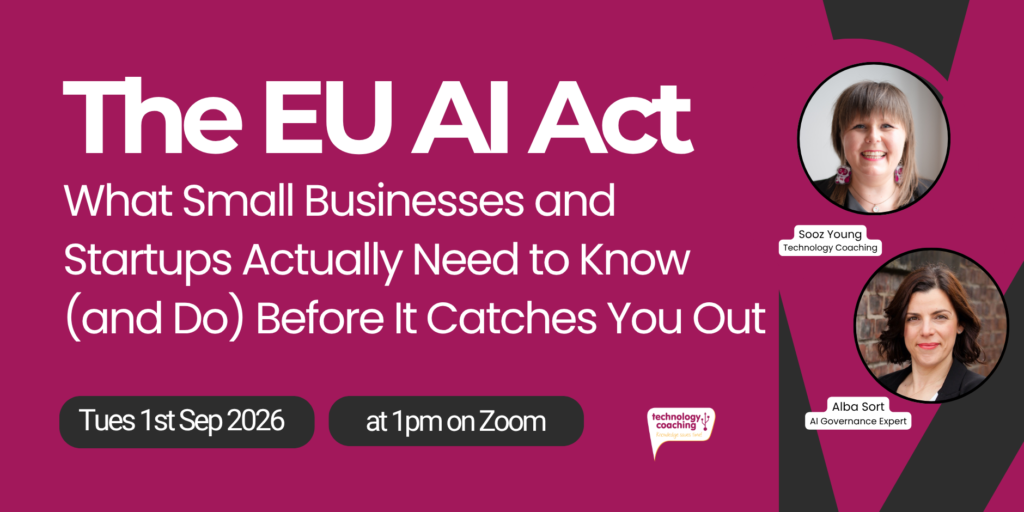
For a deeper walkthrough of this alongside the wider Digital Omnibus changes, join the FREE Masterclass session Sooz Young is running with AI governance expert Alba Sort, built specifically for small businesses and startups.
Tuesday 1st September, 1pm. REGISTER HERE
Frequently asked questions
Do I need to train staff on AI if we only use ChatGPT?
Yes. Using any AI tool, including general-purpose tools like ChatGPT, Claude, or Gemini, makes your business a deployer under the EU AI Act, and Article 4’s literacy requirement applies.
Is AI literacy training a legal requirement in the UK?
The EU AI Act applies extraterritorially, meaning it can apply to UK businesses if their AI use affects people in the EU, for example EU-based customers or clients.
UK-specific AI regulation is also developing separately, so training is good practice regardless of direct EU AI Act applicability.
How much training do I need to provide?
There’s no fixed number of hours. The requirement is “sufficient” literacy, proportionate to how your team uses AI and the risk involved.
A baseline for general use, with deeper training for anyone using higher-risk tools, is the standard approach.
Do I need to keep records of the training?
Yes. No certificate is legally required, but you should be able to show who was trained, on what, when, and with what materials if asked.
Explore Digital Skills Courses
Web Presence
Learn how the web works, how to build your online presence and create your own website
Social Media Marketing
Learn the how to promote your business and the four step process for success on social media.
AI & Automation
Understand the fundamental concepts of AI, language learning toolsand tools for automation.