She sat across from me, laughing nervously.
“I’m just not a tech person,” she said.
I asked her how long she had been telling herself that.
She went quiet. Then: “Since school, I think.”
She is in her late forties. She has built a business from nothing. She manages a team, handles her finances, and makes decisions every single day that most people would find genuinely daunting. She is capable, intelligent, and by any reasonable measure, someone who gets things done.
And yet somewhere between school and now, she had picked up a story. A quiet, background-running belief that technology was for other people. People who were wired differently. People who just got it in a way she never would.
She had been carrying that story for over thirty years.
I hear it constantly. Not occasionally, not from one particular type of person, not exclusively from people who are older or who did not grow up with computers. Constantly. From founders. From directors. From people who have built genuinely impressive things and somehow still believe that a laptop is their natural enemy.
So before we go any further, I want to say something clearly.
If that story sounds familiar, it was never yours to carry. You did not arrive at it. You were led to it.
This post is about why. And more importantly, it is about what changes when you finally understand the real reason digital skills for small business feel so hard.
The statistic that should stop every small business owner in their tracks
Let us start with a number, because this one genuinely reframes the conversation.
76% of employees report feeling underprepared to use technology effectively in their roles.
(Salesforce, 2023)
Seventy-six percent. That is not a niche group. That is not a particular generation. That is nearly three quarters of the working population feeling behind, out of their depth, or quietly blagging it when it comes to the technology they use every single day.
Now here is the question worth sitting with: if that many people feel underprepared, is the problem really with the people?
Or is it a teaching problem?
Because underprepared does not mean incapable. Underprepared means nobody gave you what you needed. Underprepared means the gap is in the support, not in you.
There is a version of this conversation where digital skills gaps are treated as a personal failing. Where the people who feel lost with technology simply did not try hard enough, pay close enough attention, or care enough about keeping up.
That version is wrong. And it has done a lot of damage to a lot of genuinely capable people.
The reality is this. Technology has been taught, sold, and in many cases designed in a way that serves almost everyone except the end user. Training sessions that assume prior knowledge you were never given. Software built by developers who have long forgotten what it feels like to be a beginner. Consultants and agencies whose business model depends, quietly and consistently, on you staying just confused enough to need them.
You did not fail to learn technology. Technology failed to be taught to you properly.
That is a completely different problem. And it is one that can actually be solved.
Why the "not a tech person" story is so hard to shake
Here is what makes this particular belief so persistent: it keeps getting confirmed.
Over and over again, by experiences that were never designed with you in mind.
You sit in a software training session and the trainer moves at a pace that leaves you three steps behind before you have even found the right screen. You feel stupid. The story gets louder.
You try to set up a new tool from a YouTube tutorial and forty-five minutes later you are more confused than when you started, because the version in the video looks nothing like the version in front of you. You feel stupid. The story gets louder.
You ask for help from someone who sighs, takes the keyboard, fixes it in twelve seconds, and hands it back without explaining what they did. You feel stupid. The story gets louder.
None of those experiences are about your ability. They are about being failed by the process. But because the process is invisible, and you are the one sitting there feeling lost, your brain does what brains do. It finds the most available explanation.
And the most available explanation is: I must just be bad at this.
The deeply frustrating thing about this story is that it becomes self-fulfilling. Once you believe it, you stop trying. You work around tools rather than learning them. You hand things off, avoid the update, ask someone else to deal with it. Every avoidance confirms the belief. Every confirmation deepens the avoidance.
It is not laziness. It is not lack of ambition. It is a completely rational response to a story you have been given enough times that it feels like fact.
You did not arrive at the conclusion that you are not a tech person. You were led to it. Which means it is not yours to keep.
What actually changes when your digital mindset shifts
This is the part I find myself most passionate about. Because the change, when it happens, is not incremental. It is not simply feeling slightly more confident opening a spreadsheet.
It is a fundamental shift in how you see your entire business.
When business owners start to understand the connections between the technology they use, not just individual tools but how everything joins up, something clicks that no amount of single-subject training ever achieves. Decisions get faster. Resources stop being wasted. The overwhelm does not disappear overnight, but it stops feeling like a verdict on your intelligence.
Here is what that looks like in practice, across four areas where I see this shift happen most consistently with my clients.
1. When social media marketing connects to your web presence
One of my clients had been posting on social media consistently for the better part of a year. Showing up every week, creating content, doing exactly what every marketing article told her she needed to do. And getting almost nothing back for it.
She was frustrated, close to giving up, and quietly convinced that social media simply did not work for her type of business.
When we sat down and looked at the full picture together, the problem was immediately obvious. She was treating her social channels and her website as two completely separate things with no connection between them. Her posts had no clear direction. There was nothing pulling someone from a piece of content into her world, onto her website, toward a conversation with her.
Nobody had ever shown her that these things are not separate. That social content exists to drive traffic. That traffic feeds data. That data tells you what your audience actually needs. That what your audience actually needs should shape your next piece of content. It is a cycle. A system. And once you understand how the pieces connect, every content decision becomes clearer and more deliberate.
That one shift, from seeing social media as a broadcasting activity to understanding it as part of a connected system, changed everything about how she approached her marketing. Within three months, her website traffic had increased by 40%. More importantly, she stopped guessing.
She had not suddenly become a marketing expert. She had simply been shown the thread.
2. When AI and automation connect to your actual workflows
The conversation around AI right now is almost entirely unhelpful for most small business owners.
It is either breathlessly enthusiastic, everything is changing, you must be using this immediately, or quietly apocalyptic, jobs are disappearing, nothing will be the same. Neither version is useful if you are simply trying to run a business and figure out where any of this actually fits into your Monday morning.
Here is what I tell every client when we start talking about AI and automation: we are not looking for the most impressive use of the technology. We are looking for the most useful one.
And the most useful one is almost always the most boring one.
One client was spending between five and six hours every single Monday on administration. Booking confirmations sent manually, one by one. Follow-up emails written and sent individually. Data copied between platforms that had no connection to each other. He was not resistant to the idea of automating any of this. He genuinely did not know where to start, and everything he had read assumed technical knowledge he had never been given.
We mapped his actual workflow together. Not the idealised version. The real one, including all the manual workarounds and the bits he had never told anyone about because he assumed that was simply how things worked. And we identified three specific points where automation made immediate, practical sense.
Within two weeks, those six hours were back in his week. Not because the technology was impressive or new. Because someone finally looked at his actual process and explained what was possible in the context of it.
Businesses that effectively integrate automation into their workflows report productivity increases of up to 30%.
(McKinsey, 2023)
But the key word in that statistic is effectively. Effectively means starting from the human process and translating it onto the tool. Not buying the tool and hoping the process follows.
Processes start with humans. Always. The technology comes after.
3. When understanding data leads to better decisions
Here is something that surprises almost every small business owner I work with.
You already have more data than you realise. You are almost certainly just not reading it.
Your website is telling you which pages people visit and which ones they leave immediately. Your email platform is telling you which subject lines people open and which they ignore. Your social channels are telling you which content people engage with and which disappears without a trace. Your sales data is telling you which services are genuinely profitable and which ones are costing you more than they are making you.
All of that information is sitting there right now. Available. Waiting.
The reason most business owners are not using it is not lack of interest. It is lack of translation. Nobody has sat with them and said: here is what this number means, here is what it is telling you, here is the decision it should inform.
Data-driven organisations are 23 times more likely to acquire customers and 6 times more likely to retain them.
(McKinsey, 2023)
Those numbers sound like they belong to enterprise businesses with entire analytics departments. They do not. The principle applies at every scale.
One of my clients runs a small consultancy. When we looked at her data together for the first time, she discovered that one of her lower-priced services was generating more enquiries, more repeat business, and more referrals than anything else she offered. She had been considering dropping it because it felt like it was not her most serious offer. The data told a completely different story.
She did not need a data analyst. She needed someone to show her what she was already sitting on.
Data does not replace instinct. It sharpens it. It gives your gut feeling something solid to lean against. And once you develop the habit of reading it regularly, the decisions that used to take days start taking minutes.
4. When teams learn digital skills together
This is the conversation that gets missed almost entirely in the digital skills world. And it is the one I think matters most.
Technology does not live in one person’s head. It lives in how a team communicates, how they hand work to each other, how they build on each other’s efforts, how they collectively solve problems. And yet the vast majority of technology training is still delivered to individuals, in isolation, and expected to somehow translate back into how a team actually functions together.
It does not work that way.
Because processes start with humans. They start in conversation, in habit, in the particular way your team has developed of getting things done. The technology is supposed to come after. Its job is to translate that human process onto a tool, to make it faster, more consistent, more scalable.
The tool does not define the process. The humans do.
When teams are given the opportunity to learn together, in environments where they can ask questions in context, practise with their actual work rather than hypothetical exercises, and see how a tool fits their specific way of operating, something happens that no individual training ever achieves. They start communicating in the same language. They stop recreating each other’s work because nobody told them a system existed. They stop losing information in endless email threads because they have actually agreed together on where things live.
Organisations with a strong learning culture have engagement and retention rates 30 to 50% higher than their peers
(Deloitte Insights)
Because learning in isolation produces knowledge. Learning together produces behaviour change.
And behaviour change is what actually moves a business forward.
The Tekunoji Method: where this all connects
Everything described above, the social and web connection, the AI and workflow integration, the data literacy, the team learning environment, is not a list of separate problems to tackle one by one.
It is one thing, seen from four different angles.
That one thing is your Digital Mindset.
The Tekunoji Method, the framework at the heart of everything we do at Technology Coaching, is built on three pillars: Strategy, Services, and Skills. Not as a hierarchy. Not as a sequence you work through once and finish. As a connected system where each pillar strengthens the others.
Strategy means understanding why the technology serves your business, not just what it does. Services means having the right tools, set up properly, working together in a way that makes sense for how you actually operate. Skills means developing the confidence and capability to use those tools consistently, not just in a training session but in the real, sometimes messy, day-to-day reality of running a business.
When all three are in place, the shift is not incremental. Technology stops being a list of things you should be doing and becomes part of how you think. It stops feeling like something happening to you and starts feeling like something you are actively using.
The overwhelm does not disappear overnight.
But it stops feeling like a verdict on your intelligence.
So what does this mean for your business right now?
If you have read this far, one of three things is probably true.
You are aware that technology is holding your business back but you are not sure exactly where the gap is. You have been avoiding certain tools or systems for longer than you would like to admit and the guilt is starting to stack up. Or you are using technology every day but you have a nagging sense that you are not getting anywhere near as much from it as you should be.
All three of those positions are more common than you think. And all three of them are fixable.
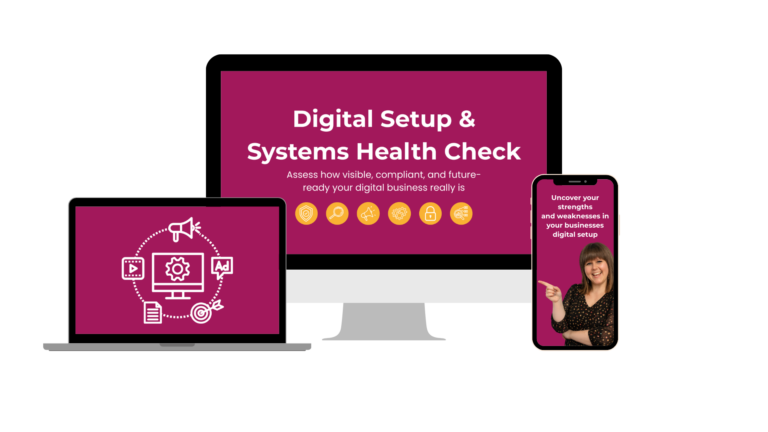
The first step, in every case, is the same. Find out where you actually stand.
Not where you think you stand. Not where you feel you should be. Where you actually are, right now, with an honest and jargon-free picture of your digital strengths and the gaps worth closing first.
That clarity changes everything. Because once you know where you are starting from, the path forward stops feeling overwhelming and starts feeling practical.
Find out where your digital skills really stand
The Technology Coaching Digital Skills Quiz takes five minutes. It gives you a clear, personalised picture of where your digital confidence is already strong, where the gaps are, and what to focus on first.
No jargon. No overwhelm. No judgment.
Just clarity about where you are starting from, which turns out to be the most useful thing of all when it comes to digital skills for small business.