“Do I need to flag my content as AI generated?”.
I was asked this question 3 times last week, on client calls, and on a podcast recording.
This was top of mind of concern for business owners/leaders and the marketers that I was speaking to.
“If I label my content as AI, won’t people trust my business less?”
I believe it’s the opposite.
That if you flag your content as AI generated, you will build more trust with your audience.
What happens when you don’t label it, and someone finds out anyway?
What the platforms are already doing
Instagram gives you two routes. Upload something made with AI tools and there’s a toggle to mark it yourself.
When you don’t flag it directly, and Instagram scans the file for AI signals through C2PA and metadata, then slaps a “Made with AI” label on it whether you asked for that or not.
There’s an account-level “AI Creator” tag now too. So it’s not just individual posts getting flagged, it’s whole profiles.
LinkedIn’s a different story entirely.
There isn’t an option to disclose yourself (yet!). LinkedIn just reads the C2PA content credentials baked into the file and decides for you.
LinkedIn started pushing video harder, started in the US earlier this year, then launched in the UK a couple of months ago.
The exact same AI slop that took over Instagram when AI video content came out, has quietly landed on LinkedIn too.
Faceless voiceover reels. AI avatars reading a script someone typed into a prompt box on the multiple AI tools that are out there (and we know as we shared over 800 in our Ultimate AI Tools List 2 years ago).
Give it two minutes of scrolling and you’ll spot three “thought leadership” carousels running the same rounded font and the same purple gradient, clearly all built off one template.
The platform where professional reputation matters most is now full of content nobody chose to flag, because there’s genuinely nowhere to press.
The ‘flag as AI’ is only possible on static posts like images and text posts. It requires the reader to flag as AI.
Which if you think about user behaviour and the fast thumbs we scroll on socials, stopping to flag as AI will be an intentional action, only taken by the few, not the majority.
TikTok & Youtube
TikTok has its own version of the toggle, similar setup to Instagram.
YouTube auto-labels anything made with its own tools and gives you a separate switch for content built elsewhere, with actual humans stepping in when something looks synthetic and wasn’t disclosed.
Youtube has been cracking down on the AI generated monetised content.
To discourage creators from using AI and other tools to make low-quality content, YouTube’s policy now explains that there are three types of videos under the broader category of “inauthentic content” that cannot be monetised.
Meta Ads
Meta’s ad platform has gone further than any of them.
Anything built using Background Generation, Image Generation or Add Animation inside Ads Manager gets labelled automatically.
No input from the advertiser at all.
Undisclosed AI content is now one of the top reasons ads get rejected there.
Why flagging builds trust rather than killing it
Trust is low right now.
Genuinely low, across the whole digital economy.
Creators are calling it the ‘trust economy’.
In the post covid even more digital world, so many businesses went digital.
Lots of ‘digital experts’ and ‘marketing bros’ suddenly appeared on the platforms. Over promising and under delivering.
People have been burned, and they remember. Fake reviews generated by AI, or just made up to gain credibility.
Scam purchases on websites that don’t have terms and conditions, leaving people out of pocket.
A chatbot pretending to be a real person on the other end of a DM, these are the most frustrating for users. Myself included. The ‘speak to a human’ request is the first I usually ask when it comes to a chatbot!
Due diligence isn’t optional anymore.
Checking a business out has become step one in discovering more about the business and not step ten.
Think about how this actually plays out when you’re looking for a solution to your problem.
You ask your network for a recommendation.
You get five or ten names back.
Before you message a single one of them, you go looking on Google.
Real business email or a Gmail account?
Privacy policy?
Terms of service?
Refund policy?
A contact page that actually goes somewhere?
Social Media accounts?
Trust reviews?
Google Reviews?
You do the work!
That’s not paranoia. That’s someone who’s been let down before, doing what they can to avoid it happening again.
An AI policy sits in exactly that bracket now.
So does being upfront about labelling.
A business that says “yes, we use AI for parts of our content, here’s how” reads as a business with its house in order.
That it knows what is the right thing to do to protect their customers in the digital space. (TRUST)
A business that hides it and gets caught out, reads as one hoping nobody would notice, or they don’t actually know what they should and shouldn’t be doing online. (LACK OF TRUST)
I saw this play out with two businesses in the same space, roughly the same week.
One posted a reel with an AI voiceover, no disclosure on the post.
Someone in the comments clocked that it didn’t sound like them straight away and called it out in the comments section.
Then did the barage of comments came!
Two days of damage control followed.
The other business posted something similar with a small line in the caption: voiceover generated with AI, script written by our team.
Nobody said a word about it, not one mention in the comments.
Which tells you something.
The label didn’t hurt them. It just meant there was nothing left to catch them out on.
A wellness coach I know built her whole lead magnet, a 40-page guide, using an AI writing tool, and put one honest line about it under the opt-in button.
Her conversion rate barely moved.
What did shift was the number of people replying to her welcome email with actual questions, because they trusted the guide enough to engage with it properly instead of skimming and bouncing!
The Vibe coded AI website/tool question nobody's asking yet
If your entire website came out of a no-code AI builder, prompt to launch in an afternoon, here’s a question worth sitting with.
Do your visitors know that?
Is anything said about how their data’s handled, whether a real person looks at enquiries before they go anywhere, what happens if something goes wrong?
What happens to their personal data when they share it with the tool?
Where is this data stored?
How can the user manage their personal data?
Who owns the IP from the generated content from the tool?
What risks does the user have when they use the website/tool?
A fully AI-built site isn’t the problem on its own.
It’s an AI-built site with zero transparency about how it works, and zero indication of what’s protecting the person using it, that turns into a liability the moment someone checks.
Say you built a booking site this way, chatbot included, and that chatbot handles every first enquiry before a human sees any of it.
Someone lands on the site, chats with what feels like a real person, books a call, then finds out three days later the whole thing was an AI agent start to finish.
Nothing dishonest happened technically.
The booking went through. The service got delivered.
But that visitor feels tricked, and the feeling sticks to your brand, not to whatever tool you happened to build the site on.
Now compare that to the same setup with one line under the chat window: “This chat’s handled by an AI assistant.
A team member reviews every booking personally.”
Same tool, same chatbot, same flow.
Completely different experience, because the person on the other end actually knew what they were talking to.
If you make content for someone else
Contractors and VAs producing content on a client’s behalf; copy, imagery, whatever, sit inside the EU AI Act’s transparency rules too.
Article 50’s been live since August 2nd.
If you’re publishing under someone else’s brand, you and your client need to be on the same page.
What gets disclosed. How. Who’s actually responsible for it.
Get that in writing before your next contract renews.
Not after a client asks why one of their posts got flagged.
I even recommend that if you’re generating AI content on behalf of a client.
You use their AI tool and not your own.
For example, you ask them to give you a business AI account that you can log into, where all the content that is generated on their login.
To go one step further.
They give you a business email address, a business Google Account, where all the passwords are managed.
You log into that Google Account (that is owned and managed by the client – not one you’ve created), and access the AI tool (e.g. Claude) that has been setup by the client.
Any time you work on that clients work, you are using their accounts at all times.
This is a safer way to manage logins and access, data and IP as business and on behalf of a business.
I think about the VA managing five client accounts, writing captions, building carousel graphics, scheduling everything with AI tools across all five.
She’s carrying disclosure responsibility for every single one of those accounts, not just her own work.
If even one client’s audience sits in the EU and the content reaches them, Article 50 applies, regardless of where she’s based or where her client’s business is registered.
This is even more prevalent on social media, because we have no control over who sees our content on the platforms.
Not this doesn’t need to be complicated.
One clause in the contract covering which content involves AI, who reviews it before it goes out, who owns the disclosure call on each platform, what accounts should be used and how its accessed.
Takes time to write and add to contract, but once signed, saves a genuinely awkward conversation down the line when a client’s own client starts asking why a testimonial graphic looks suspiciously polished!
Personal use versus business use
Using AI to draft a personal caption is not the same decision as using it to build out an entire client content calendar.
Personal accounts carry less regulatory weight, less reputational risk, less at stake if someone notices.
Business accounts, especially ones selling anything that depends on trust, need an actual policy.
Not a paragraph buried three pages into your terms and conditions. Something clear, in plain language, that people can find without having to hunt for it. (TRUST UPFRONT).
Here’s an example.
Two founders post almost identical content. A morning routine reel, filmed on a phone, run through an AI tool that smooths the audio and adds captions.
One posts it to a personal account, just documenting a normal week.
The other posts the same reel to a business account promoting a coaching offer, caption underneath selling something built entirely on personal trust.
The tool did exactly the same job both times.
But the stakes attached to disclosure are nowhere near equal, because one is asking for a follower’s attention and the other is asking for a client’s money.
What to do this week
Map out where AI actually touches your content.
Copy,
images,
video,
voice,
website,
offers,
digital products,
all of it.
Decide what gets flagged and how you’re going to say it.
Put a short AI policy somewhere on your website, something your team and your clients can point back to.
Have a longer more detailed policy and guidelines for staff in house, have your team sign that they understand. Check their work flow, whilst you get this into a routine.
And if you outsource content at all, have the flagging conversation with whoever’s doing it before the next brief goes out, not after something’s already live.
None of this slows a business down.
If anything, it’s the thing that gets you found and trusted before a competitor who’s staying quiet about theirs.
EU AI Act Masterclass
Now there’s a lot more to this that I won’t go through in this newsletter. There’s a lot more to what’s required for businesses and individuals using AI that is now required.
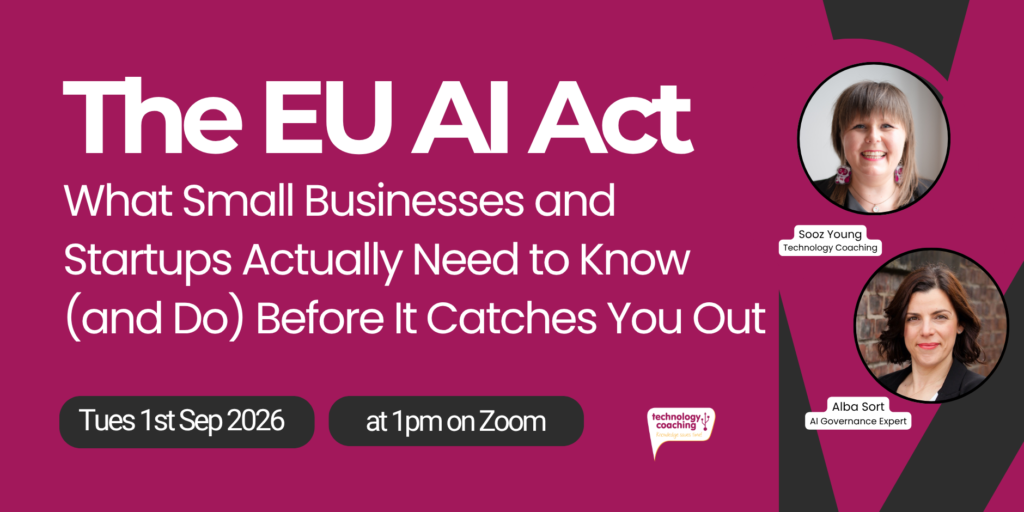
To help get you building that trust with your customers. I’m running a live masterclass on 1st September with AI governance specialist Alba Sort.
We’ve specifically built this session, for small businesses and startups who need the EU AI Act explained in plain English, not legal jargon or focused towards the larger corps.
We’ll cover Article 50 disclosure requirements, what’s changed since the Digital Omnibus split the compliance timeline, and how to actually build an AI policy that protects your business rather than just ticking a box.
You can register for free here -> The EU AI Act: What Small Businesses and Startups Actually Need to Know – Technology Coaching
The session will be recorded and any attendees get a checklist of what they need to do after the session.
Explore Digital Skills Courses
Web Presence
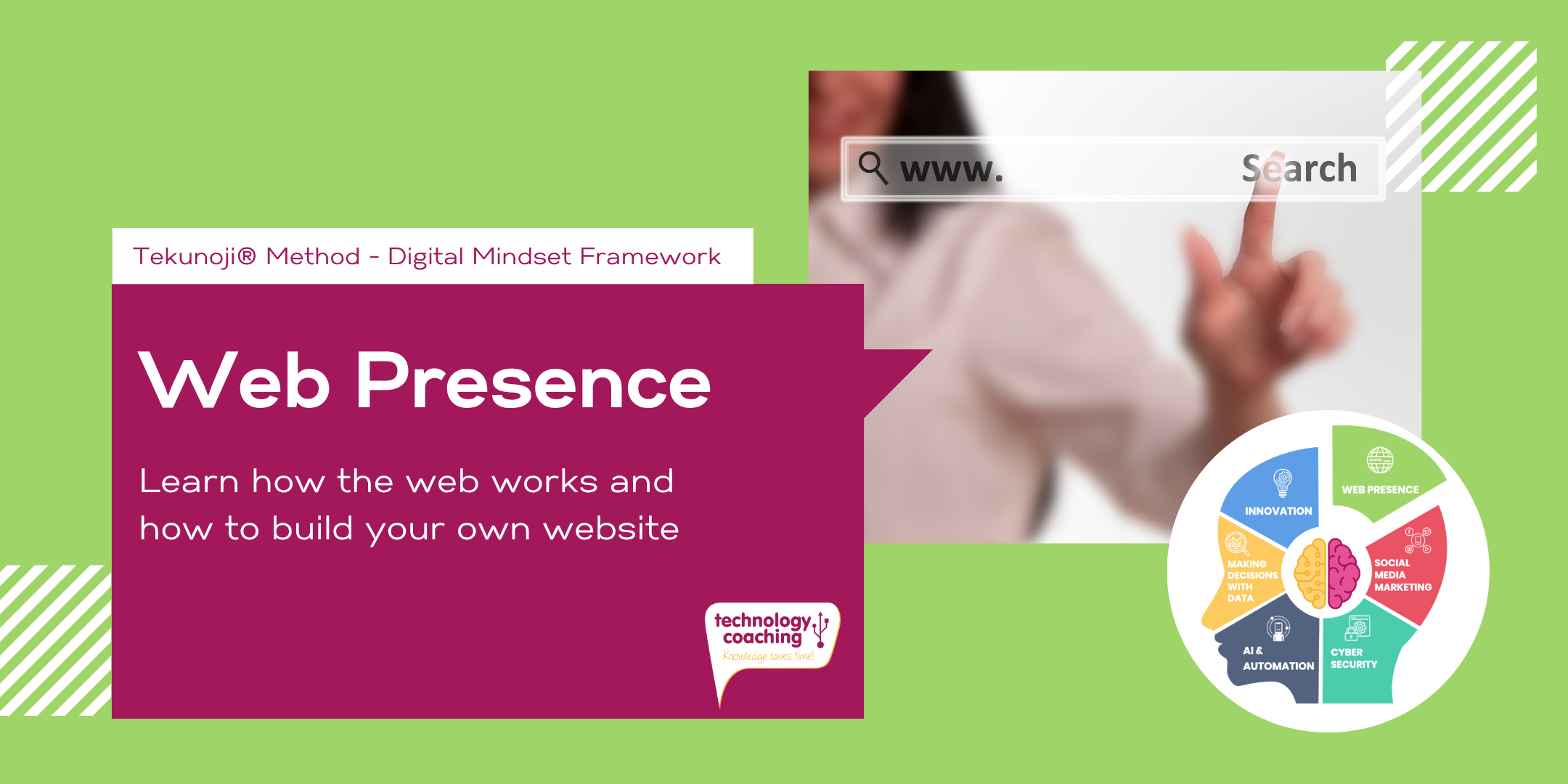
Learn how the web works, how to build your online presence and create your own website
Social Media Marketing
Learn the how to promote your business and the four step process for success on social media.

AI & Automation
Understand the fundamental concepts of AI, language learning toolsand tools for automation.